
Learn

What is Learn?
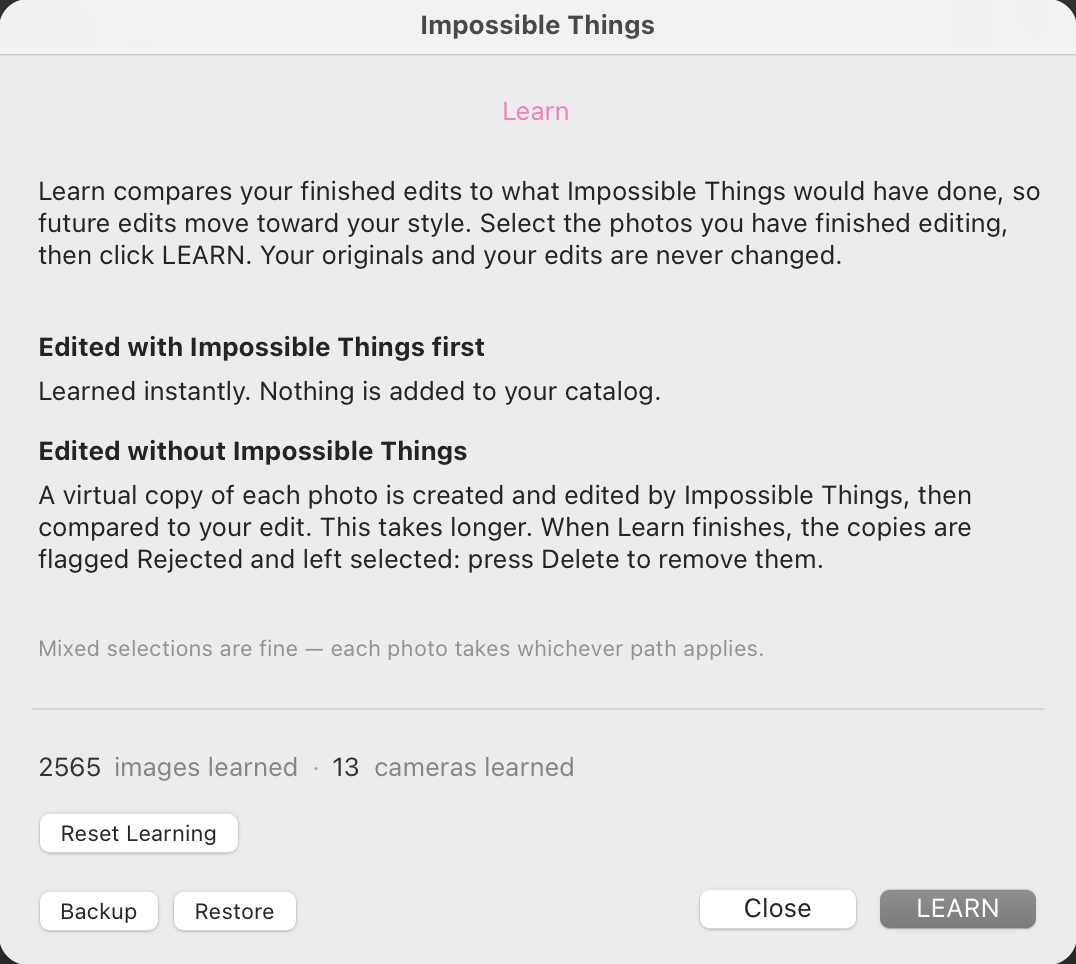
Learn teaches Impossible Things your personal editing style. It compares the photos you've finished with what Impossible Things would have done on its own, keeps only the difference, and applies it to every edit from then on.
There's no minimum or maximum number of photos. A handful is enough to start, and results improve steadily as you learn from more. Your learning profile is saved to your account, so it follows you to any computer you log in on. Your photos and presets are never stored, and your originals and edits are never changed.
Learn is optional. Impossible Things comes pre-tuned and gives good results with no learning at all. Learn is how you make those results yours.
How It Works
- Edit your photos with Impossible Things (File ▸ Plug-in Extras ▸ Impossible Things ▸ Edit Photos).
- Adjust or refine the results however you like. Make your normal corrections to finalize the edit.
- Select the finished photos and go to File ▸ Plug-in Extras ▸ Impossible Things ▸ Learn.
- Click LEARN.
That's it. Your preferences are now part of future edits. Nothing to select, nothing to switch on.
Learning from photos you edited without Impossible Things
Learn also works on photos you finished before you ever used the plug-in, or edited entirely by hand. Select them and click LEARN. Impossible Things creates a virtual copy of each photo, edits the copy, and compares it to your version. This takes longer than learning from photos it edited first.
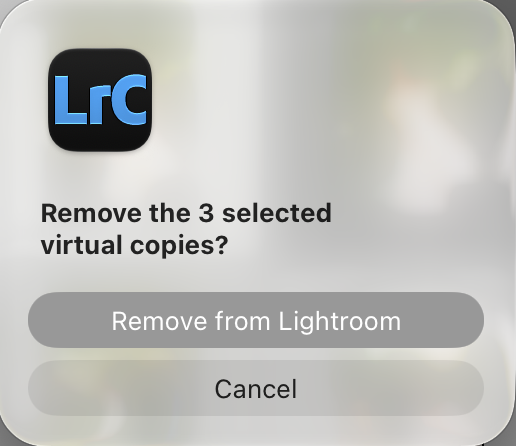
When Learn finishes, the virtual copies are flagged Rejected and left selected. Press Delete in the Library module to remove them. Your originals are not affected.
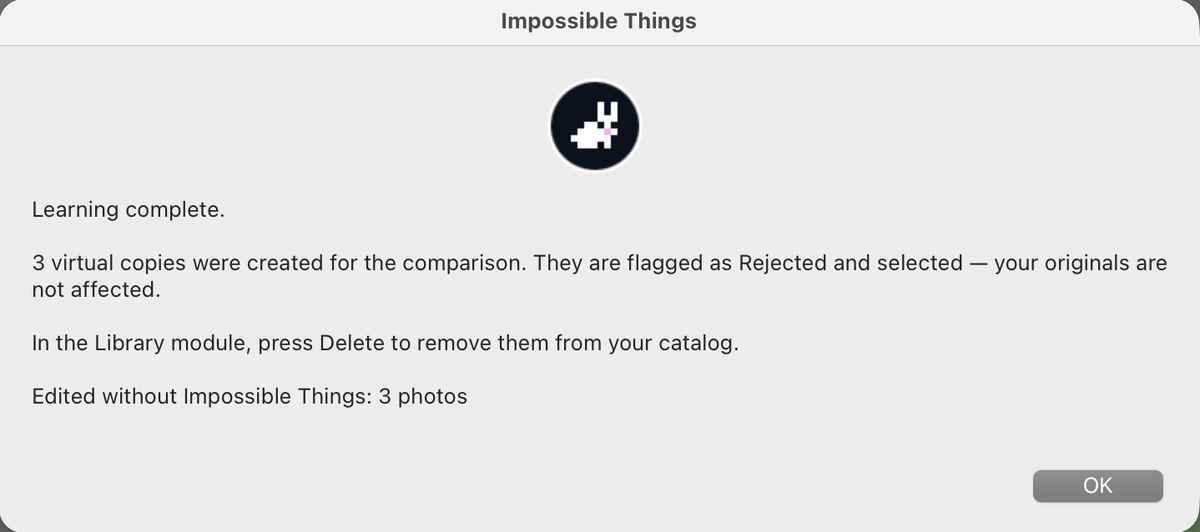
This is the quickest way to give Impossible Things a head start from past jobs before your first edit. You can mix both kinds of photos in one selection. Learn works with RAW and DNG photos. On credit plans, each virtual copy counts as an edit. On Unlimited plans it's free.
What Learn actually learns
Before Impossible Things touches a slider, it places each photo within four things it has learned from a huge library of professional frames:
- The light it was shot in – dozens of lighting situations, from bright open sun to dim receptions to strong backlight. Flash and natural light are kept apart.
- How the light falls in the frame – close to thirty exposure patterns, so a backlit portrait, a hard-shadow frame and an evenly lit one are all treated differently, even when they're equally bright overall.
- The colour of the light – nearly thirty white-balance situations: tungsten, fluorescent, cool shade and overcast, warm golden hour, and everything in between.
- The camera you shot it with – every body renders exposure and colour a little differently, and so does the way you edit each one. Impossible Things learns how and why you treat your Canon differently from your Sony, or your main body differently from your second.
A photo is never forced into one box. Impossible Things sees how close a frame is to the nearest few situations in each set, so a shot that falls between two of them is treated as a bit of both. That's why it's consistent across a job: photos taken in the same conditions, on the same camera, land in the same place and get the same treatment.
When you run Learn, it recognises each photo's situations and camera, compares what it would have done with what you actually did, and keeps only the difference – a little brighter here, a touch warmer there – filed under those situations and that camera. On a new photo it predicts as normal, then applies your differences. Situations and cameras you've taught it well get your full correction; neighbouring situations get a gentle nudge in your direction; anything you've never covered is left alone.
What that means for you
- Learn corrects Impossible Things, it doesn't replace it. As the engine improves, your profile keeps riding on top.
- Learn is specific. Teaching it your backlit look changes your backlit results, not your indoor ones. Teaching it one camera doesn't blur into another.
- A little goes a long way. A handful of finished photos from a situation is enough to start; the more situations and cameras you cover, the more of your work it recognises.
- It's one profile that follows you. Learn is saved to your account, with Backup, Restore and Reset Learning in the Learn dialog.
Learn and Quick Tune
Learn applies to every preset you use. Quick Tune is per preset: a fixed starting point for one look. Both are applied together on every edit. Run Quick Tune on a preset before you first edit with it, then let Learn take it from there. You can Quick Tune a preset again at any time; it measures only what is still off. [ Quick Tune ]
Backup, Restore and Reset Learning
- Backup saves a snapshot of your learning profile on this computer and to your account.
- Restore brings that snapshot back. The button shows the backup's date and appears once a backup exists. A backup made on one computer can be restored on another with the same account.
- Reset Learning clears your learning and cannot be undone. Make a Backup first.
If you want two genuinely separate looks, such as a second brand, Backup before learning the other look, and Restore to go back.
Tips for Best Results
- Learn after finishing a job's edits, not from half-finished work.
- Mixed presets are fine. Learn detects which preset each photo was edited with and accounts for it.
- More lighting variety helps. A few dozen photos across your usual situations is a good base.
- Learning adds up. Each Learn run refines what's there.
- If the results went the wrong way, click Backup, then Reset Learning, and learn again from a set of finished edits you are happy with.
Coming from version 1.92?
Learning gathered with the previous engine can't be carried over. The first time you edit or learn after updating, you'll see a one-time notice that your learning profile has been reset. A copy of your old learning is saved on that computer. Learn from a set of finished photos and Impossible Things picks your style up again, usually with fewer photos than before. If you'd rather keep editing with the old engine and your old learning for now, see Editing engine (advanced).